Disclosure: This post contains affiliate links. If you purchase through our links, Tesova may earn a small commission at no additional cost to you. This does not influence our editorial opinions or review process.
Skincare Technology — Honest Review
I Added an At-Home Facial Device to My Skincare Routine. Here's What Eight Weeks of Consistent Use Actually Looked Like.
I was skeptical of at-home devices — until a dermatologist friend walked me through the research. I committed to eight weeks of daily use and kept notes. Here is the unfiltered version.
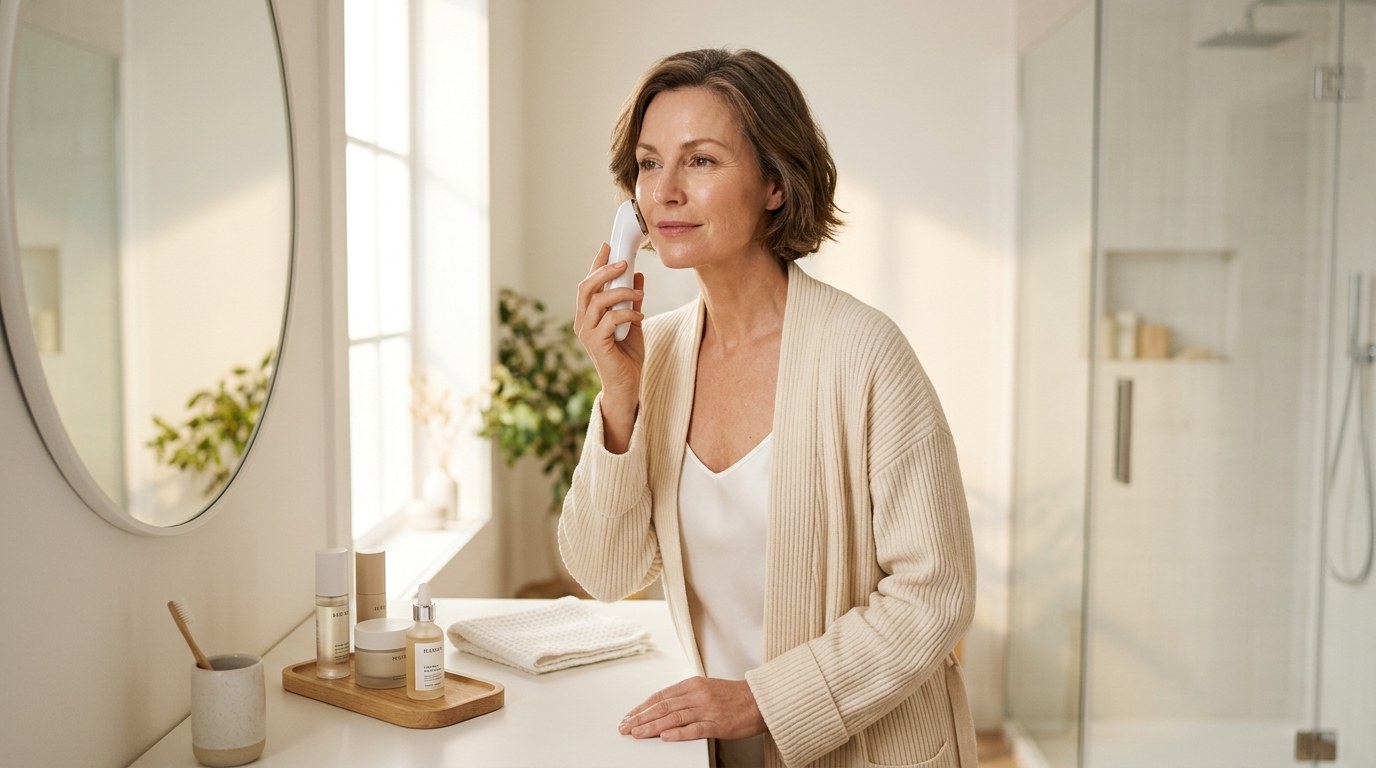
I have a confession: I spent years being dismissive of handheld facial devices. The category always felt aspirational in a vague, late-night-infomercial kind of way. Dermatologists had lasers and professional equipment. At-home devices were, in my mind, watered-down approximations that mostly sold on aesthetics and hope.
Then, at dinner with a friend who has been practicing dermatology for fifteen years, I made the mistake of saying that out loud.
"That was true ten years ago," she told me. "The technology has genuinely moved. Some of the consumer devices coming out now are using the same wavelengths as clinical tools. At lower intensities, but the mechanism is real." She went on for twenty minutes. I went home and started researching.
Eight weeks later, I have an opinion. Here is everything I found.
The Technology: What's Actually Happening
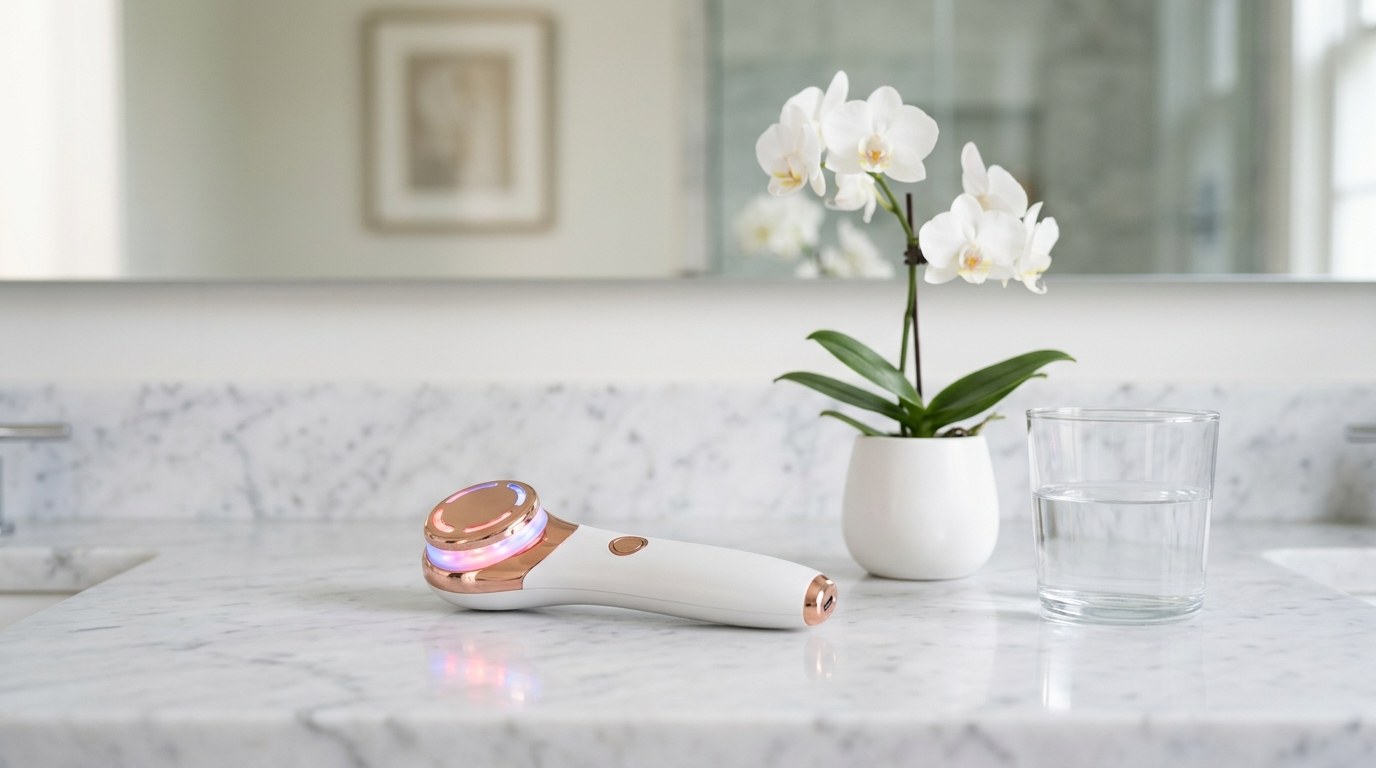
The category of at-home facial devices has expanded significantly in recent years, with the most well-researched tools falling into two main types: LED light therapy and microcurrent/EMS (electrical muscle stimulation) technology. Some devices combine both. The one I committed to testing uses LED phototherapy — specific wavelengths of light that penetrate the skin at varying depths depending on the color.
The research on this isn't new. Red light therapy (typically around 630–660nm) has been studied in clinical settings since the 1990s, and near-infrared light (around 830nm) has an even longer research history in wound healing and tissue repair contexts. The mechanism involves light energy being absorbed by mitochondria in skin cells, which may support collagen synthesis, improve circulation, and promote overall cellular activity in the treated tissue.
What's changed is that miniaturized LED technology has made clinical wavelengths accessible in compact consumer formats. My dermatologist friend was right: the gap between clinical and consumer-grade devices has narrowed substantially. The consumer versions still operate at lower intensities, which means the per-session effect is smaller — but daily use over time can accumulate into something meaningful, according to the research.
"The clinical literature on red and near-infrared light therapy spans decades and thousands of studies. The consumer devices now reaching the market are using the same wavelengths — just at lower intensities. Daily consistency matters more than session intensity at this level." Dermatology practitioner, personal conversation
What the Research Shows
Red Light (630–660nm)
Absorbed primarily in the dermis, where collagen-producing fibroblasts are most active. Multiple clinical trials have found that consistent red light exposure may support skin texture and firmness over time. Results are typically gradual, appearing over weeks to months of consistent use.
Near-Infrared Light (830nm)
Penetrates deeper than visible red light, reaching the subcutaneous layer. Near-infrared has been studied extensively in tissue repair and inflammation research. In facial applications, it may support circulation and overall skin wellness in the deeper layers.
Collagen Synthesis Support
Some of the most consistent findings in photobiomodulation research relate to fibroblast activity — the cells responsible for producing collagen and elastin. Studies suggest that the right wavelengths may create a measurable cellular response that supports these structural proteins over time.
Circulatory Effects
Light therapy may support microcirculation in the skin, which has downstream effects on how nutrients are delivered and how efficiently metabolic byproducts are cleared. Some users notice a visible post-session brightness that many researchers attribute to this circulatory response.
I want to be honest about the limits of the research at the consumer level. Most of the robust clinical studies use professional-grade equipment at higher intensities than consumer devices provide. Results vary based on skin type, device quality, consistency of use, and individual factors. The research is genuinely encouraging, but it isn't conclusive at consumer intensities, and I went into this experiment trying to keep that in mind.
Eight Weeks of Daily Use: My Honest Notes
I used the device for five to seven minutes every morning, after cleansing and before applying serum. I kept the rest of my routine identical throughout — same cleanser, same moisturizer, same SPF. If I was going to notice something, I wanted to be confident it wasn't a product variable.
Weeks One and Two: Getting the Habit In Place
The first two weeks were about establishing the routine more than observing results. The device is compact and takes about five minutes to use, which made it easy to slot into my existing morning flow. I noticed a pleasant warmth during use — not uncomfortable, just a sense of something happening. By the end of week two, my skincare felt like it was absorbing more efficiently after sessions, which I'd later read is a commonly reported effect.
I was deliberately trying not to project meaning onto anything in these early weeks. Five minutes of light on your face every morning is a real behavior change, and the human tendency to notice improvements after investing in something is well-documented. I wanted to give it time before drawing any conclusions.
Weeks Three and Four: First Observations
Somewhere in the middle of week three, I noticed my skin looked brighter on mornings after device sessions than on the two mornings I'd skipped. My husband — who has never once commented on my skincare routine in eighteen years — asked if I'd gotten more sleep. I hadn't. But I took the comment as a data point.
By week four, I was noticing that the texture of my skin, particularly on my cheeks, felt more even under my fingertips during my morning routine. The slightly dry patches I typically manage through fall and early winter were less pronounced. I wasn't sure whether to attribute this to the device or to the hydration routine I'd been slightly more consistent with — but the timing corresponded with the device use.
Weeks Five and Six: More Established Patterns
By week five, I felt like the pattern was real enough to report with some confidence. My skin consistently looked more even-toned and brighter on mornings after sessions. The texture improvement I'd noticed at week four had continued and felt more established — not a dramatic change, but a consistent shift in how smooth and comfortable my skin felt throughout the day.
I also noticed something I hadn't anticipated: I was enjoying the five minutes. There's something genuinely centering about a short, intentional ritual to start your morning — warm light on your face, quiet, unhurried. Whether that contributed to how I perceived the results, I can't rule out. But the skin changes felt concrete enough to keep tracking.
Weeks Seven and Eight: The Full Picture
The final two weeks confirmed what weeks five and six had established. My skin looked the most consistently even and luminous it had in years — and I'm saying that as someone who has a decent skincare routine and generally takes good care of herself. The device appeared to add something the topicals alone weren't providing.
My dermatologist friend, who I saw for an unrelated reason during week seven, noticed the change without me mentioning anything. She asked if I'd started something new. When I told her about the device, she wasn't surprised. "Daily consistency matters more than session intensity at this level," she said. "You're getting cumulative effects from weeks of cellular stimulation." That framing felt right to me.
What Other Women Are Reporting
★★★★
"I've tried a lot of at-home devices over the years and most of them end up in a drawer within a month. This is the first one that actually became a real part of my routine — and the first one where I started to genuinely notice my skin looking different. My friends asked if I'd had something done. I told them it was a device and showed them on my phone. Now three of them have ordered one."
Jennifer M., 51 — Verified Purchase
★★★★★
"My skin feels noticeably softer and more even — the texture around my forehead and cheeks is better than it's been in a long time. I use it every morning for about five minutes and it's become as automatic as brushing my teeth. I was genuinely skeptical before I tried it, but eight weeks in I'm a convert. Easy to recommend."
Patricia L., 47 — Verified Purchase
★★★★☆
"Results are gradual and I want to be realistic about that — this isn't dramatic change overnight. But after six weeks of consistent morning use, my skin tone has evened out noticeably and the overall brightness is real. My aesthetician asked what I'd changed. This takes some patience but if you stick with it, I think it's worth it."
Karen R., 44 — Verified Purchase
Curious about adding a professional-grade facial device to your skincare routine? This is the one I tested for eight weeks — here's where to find current pricing and availability.
See Current Pricing →What Makes a Good At-Home Facial Device
After eight weeks of use and a fair amount of reading on the subject, here is what I think actually matters when evaluating this category:
- Clinical wavelengths: Red light at 630–660nm and near-infrared around 830nm are the ranges with the most research support. Devices using these specific wavelengths are drawing on meaningful science, not just aesthetic marketing.
- Consistent daily use: The research on photobiomodulation is clear that cumulative, consistent exposure matters more than single high-intensity sessions. A device you'll actually use every morning is worth more than one with impressive specs that lives in a drawer.
- Ease of use: The device I tested takes five minutes. That's the right length — long enough to be meaningful, short enough to fit into a real morning routine without becoming a burden.
- Quality construction: At-home devices have a wide range in build quality. Look for something with medical-grade LED panels and a battery that holds a charge reliably over months of daily use.
- Safety certification: FDA-cleared devices have gone through regulatory review for safety at the consumer level. This is worth checking before purchasing anything that will be used near your eyes and face daily.
Is This Right for You?
Based on my experience and the research I read, at-home LED facial devices tend to resonate most with women who are already thoughtful about their skincare routines and are looking for a technology-backed complement to their topicals. The research is most consistent for women noticing the kinds of gradual changes that come with age — uneven texture, reduced brightness, less firmness in the skin's surface — and who want a research-supported approach rather than relying entirely on topical products.
I'd caution against expecting rapid dramatic results. This category rewards patience and consistency. The women who seem most satisfied with at-home devices are the ones who approach it as a long-horizon habit rather than a quick fix. If you can commit to five minutes every morning for at least eight weeks, you're giving it a real chance to show what it can do.
As always, if you have specific skin concerns or take photosensitizing medications, check with your dermatologist before starting any kind of light therapy routine. And use SPF — light therapy makes it even more important than usual.
My Verdict
I went into this experiment skeptical and came out a genuine convert — which, given my starting position, is the strongest endorsement I can offer. Eight weeks of daily use left my skin looking more even, brighter, and smoother than it had in years. The changes were gradual and cumulative, which is exactly what the research would predict. No single morning was dramatically different, but the arc over two months was real and consistent enough that people who see me regularly noticed without me mentioning it.
If you've been curious about LED facial devices but held off because the category felt gimmicky, I'd say the technology has genuinely matured. Not all devices are created equal — look for clinical wavelengths, quality construction, and a realistic commitment to daily use. This is the one I can personally speak to, and after eight weeks, I would buy it again.
Ready to See for Yourself?
This is the device I used for eight weeks of daily testing. Here's where to check current pricing and availability — scroll the reviews to see what long-term users report after consistent use.
See Current Pricing →Individual results may vary. Use SPF daily when using any light therapy device. Consult your dermatologist if you take photosensitizing medications.
Note: This article is for informational and editorial purposes only. Results from at-home devices vary by individual, skin type, and consistency of use. The testimonials included reflect individual experiences and should not be taken as typical results. Always consult a licensed dermatologist or skincare professional before beginning a new device-based skincare regimen, especially if you have active skin conditions.